

Migration
Click and collect, set up so it survives a Friday
The four settings that decide whether collection works or falls apart: lead time, slot capacity, what you do with the packaging, and the handover at the counter.
 Harry Soar23 August 20263 min read
Click and collect is the best-margin order a restaurant takes. No commission if it came through your own site, no courier, no delivery fee, and no thirty minutes in a bag on a bike deciding what the food tastes like when it arrives. It is also the channel most often switched on with the defaults left alone, which is why it goes wrong.
Turning it on is a checkbox. Making it survive a Friday is four settings and one habit at the counter.
1. Lead time, and why one number is wrong
The single quoted prep time is the most common mistake. Fifteen minutes is true at three on a Tuesday and a lie at seven on a Friday, and the customer who turns up to a fifteen-minute promise at the exact moment your kitchen is forty minutes deep is the customer who leaves the review.
What works is a lead time that moves with the queue, so the quote reflects what the kitchen is actually carrying. If your system cannot do that, the safe version is to quote the honest bad-case number rather than the good one. An early collection is a nice surprise. A late one is a complaint.
2. Slot capacity, or the seven o'clock pile-up
Without a cap on how many orders a slot can hold, everyone picks the same three slots and the kitchen gets a week's worth of tickets in twenty minutes. Capacity per slot is what turns collection from a spike into a queue you can cook.
Set it from what the kitchen can actually produce alongside the walk-in trade, not from what you would like it to be, and set it lower for the peak than for the shoulder. Capacity control is where we do this. Whatever you use, the test is whether a customer can book into a slot that is already full.
3. Packaging is a decision, not a default
Collection is not delivery and does not need delivery packaging. Some of it should not be packed at all until the customer is at the counter: chips steam in a closed box, a burger softens, anything crisp stops being crisp.
Split the menu into what can be bagged on the pass and what should be finished on arrival, and take the items that genuinely cannot survive either off the collection menu. A per-channel menu is what makes that possible without maintaining two of everything.
4. The handover, which is the whole experience
Everything above is invisible to the customer. The counter is not. The failure is always the same: someone walks in, cannot see where to go, waits behind the walk-in queue they thought they had skipped, and the point of collection evaporates.
What fixes it is boring and physical. A named place to stand or a shelf with order names on it. Somebody whose job includes looking up. Orders staged in collection order rather than in the order they were cooked. If collecting takes longer than queuing, people go back to queuing, and no software fixes that.
The habit: tell them it is ready
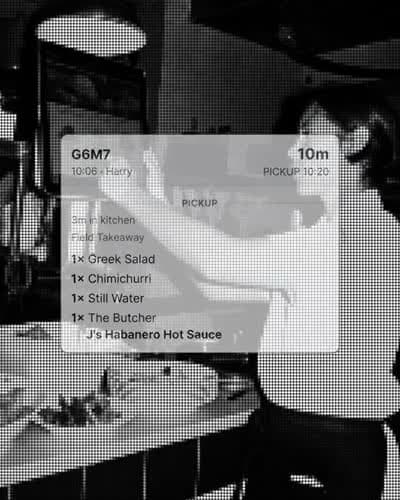
A collection order that is ready and unclaimed is food getting worse. A notification when the order is actually ready, rather than when it was accepted, is the difference between a customer who arrives at the right moment and one who arrives whenever. Order tracking covers this, and it is worth as much to the pass as it is to the customer.
Where to start
If you are switching it on this week: cap the slots first, quote the honest lead time second, and fix the counter before you promote it anywhere. The marketing is the last step, not the first, because collection that works sells itself to the same customer twice and collection that does not gets one go.
Our side of it is ordering for takeaway and collection, and the takeaway system is where the slots, the menu and the notifications sit together.
Questions operators ask
How does click and collect work in a restaurant?
The customer orders and pays on your site or app, picks a collection slot, and comes to the counter. The order goes to the kitchen like any other ticket, is staged for its slot rather than cooked immediately, and is handed over at a defined collection point. No courier and no delivery fee are involved.
What lead time should you set for collection orders?
One fixed number is the usual mistake, because it is honest off-peak and false at peak. A lead time that stretches as the queue grows is the right answer. If your system cannot do that, quote the bad-case time rather than the good one: an early collection is a nice surprise and a late one is a complaint.
Why cap how many orders a collection slot can take?
Without a cap, customers cluster into the same few slots and the kitchen receives a spike it cannot cook alongside walk-in trade. Capacity per slot spreads the same orders into a queue you can work. Set it from what the kitchen actually produces at peak, not from what you would like.
Is click and collect more profitable than delivery?
Usually, and by a wide margin. There is no marketplace commission on an order from your own site, no courier cost, and no delivery fee suppressing basket size. Food quality is also better, because nothing spends the journey in a sealed bag.
More from the blog
GloriaFood alternatives
A fair comparison of the realistic GloriaFood alternatives - Storekit, Flipdish, CloudWaitress, Square, Toast, and ChowNow - and how to switch without losing your data.
Harry Soar · 10 June 2026 · 6 min read
Read post →
Export your GloriaFood data
Your menu, guest list, and order history disappear with GloriaFood's servers on 30 April 2027. What to export, in what order, and what to check before you trust the copies.
Harry Soar · 10 June 2026 · 2 min read
Read post →
Your GloriaFood website
The $9/month Sales Optimized Website disappears with the rest of GloriaFood on 30 April 2027. What happens to your domain, your Google presence, and your ordering links.
Harry Soar · 10 June 2026 · 2 min read
Read post →
Ready to
move?
Free to set up, live the same day, and your guest list comes with you.